The instrument
Scalloped frets: what they are, how they play and why Uli Jon Roth uses them
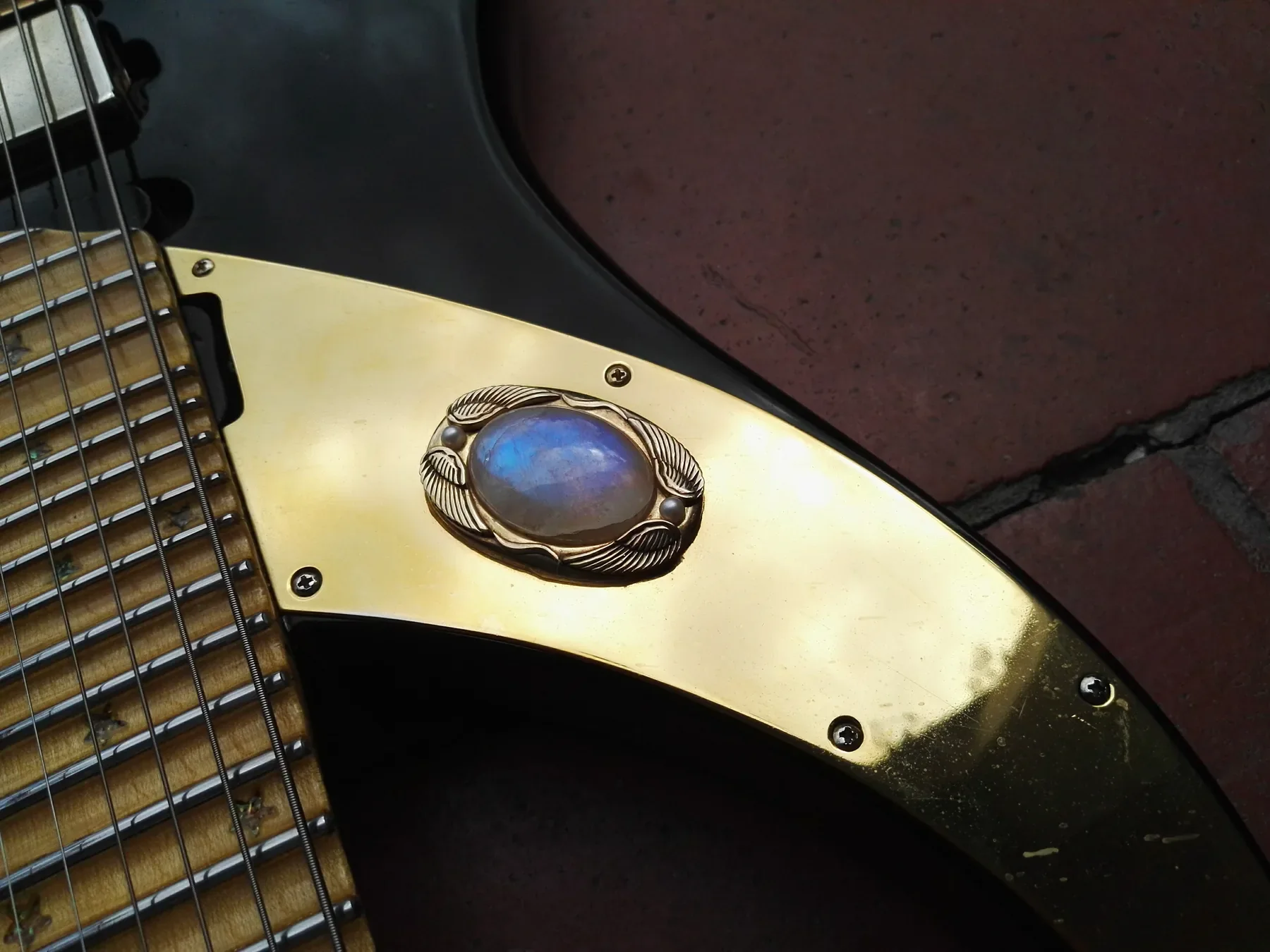
A scalloped fretboard is one from which wood has been removed between each pair of frets, leaving a U-shaped hollow. The fingertip presses the string down without ever reaching the wood: vibrato and bends take less effort, but any excess pressure pushes the note sharp.
3 notes on disputed or unconfirmed data
- Sources contradict each other on whether every Sky Guitar has a scalloped fingerboard. English Wikipedia states that all the ones with frets do; the official spec sheets on sky-guitars.com describe at least one unscalloped model (Dolphin Sky) and two scalloped only in the upper register. This page gives both versions without choosing between them.
- German Wikipedia places the Sky Guitar's scalloping from the 4th fret. None of the official spec sheets consulted mentions the 4th fret: the figures that appear are 3, 6, 7, 27, 'all the way' or 'not scalloped'. Disputed figure.
- The scalloping specifications in the table come from the sky-guitars.com product pages consulted in September 2026. These are handmade, made-to-order instruments and the spec sheets can change without notice: the specification in force is always the one on the official site.
What a scalloped fretboard is
A scalloped fretboard is one from which wood has been removed between each pair of frets, leaving a U-shaped hollow between them. As a result, the distance between the string and the wood of the fingerboard increases, and the finger stops rubbing against that wood: the only contact is between fingertip, string and metal fret (Lefty Fretz).
Scalloped fretboard is the term you will see on any spec sheet, the Sky Guitars’ included. In Spanish, the main language of this site, the words escalopado, scalloped and, less often, diapasón excavado all live side by side. They all mean the same thing.
The operation does not change the scale length, the tuning or the position of the frets. It changes just one thing: what your finger does when it frets a note.
How technique changes: pressure, vibrato, bends and intonation
Scalloping turns finger pressure into a musical parameter. That is the whole story.
On a flat fingerboard, the finger reaches the wood and stops there: the string is held against the fret and you cannot push any further. On a scalloped fingerboard there is no stop. If you keep pressing, the string stretches, and stretching a string is exactly what a bend does. The source puts it without ambiguity: pressing too hard has the same effect as a small bend, and the note goes sharp (Lefty Fretz).
What you gain
- Vibrato. You can modulate pitch with the vertical pressure of the finger, without having to move your hand sideways. It gives you a violin-style vibrato that on a flat fingerboard requires different mechanics.
- Bends. With no friction against the wood, the string travels with less effort. Long bends are less tiring.
- Microtuning. Very small pitch variations, below a semitone, can be made through pressure alone. It is the gateway to quarter tones and to ornaments that sound more like a bowed instrument than a guitar.
What you lose
- Chords. This is the documented weak spot. With too much pressure the chord goes out of tune; with too little, it buzzes. Finding the middle ground on five or six strings at once is much harder than on a single note.
- Margin for error. A heavy fretting-hand technique, the kind that grips the neck hard, sounds wrong from the very first minute. Scalloping is unforgiving.
- Rhythm playing. It follows from the above: sustained accompaniment chords are precisely what sits worst with a scalloped fingerboard.
There is a design trick that tackles this problem. Ritchie Blackmore uses asymmetric scalloping, deeper on the lower side and flattening out toward the headstock, precisely to force himself to fret close to the wire and so improve his intonation (Lefty Fretz). Blackmore, incidentally, is among Uli Jon Roth’s declared influences.
Why Uli Jon Roth uses scalloped frets
Roth has explained the trade-off in his own words, in an excerpt from an April 2001 Guitar Player interview reproduced on the long-running fansite Edenwaith, the page English Wikipedia cites for its Sky Guitar section (the encyclopedia itself does not carry the quote): “It’s still a hindrance for playing rhythm, but I definitely prefer a scalloped neck for single-note work – it gives me much more control over the notes.”
That sentence sums up the whole exchange: melodic control in return for harmonic comfort. And it fits the goal Roth was pursuing when he commissioned the first Sky Guitar in 1983: he wanted an instrument that could play the exact part of a violin concerto without transposing the melody down an octave. If what you are after is a violin’s phrasing, scalloping is not a whim: it is the tool that gives you the vibrato and the microtuning that phrasing needs.
Scalloping also has a documented relationship with the upper part of the neck. Above the 27th fret the Sky Guitars switch to whole-step fret spacing, and some versions have no frets at all above the 30th (English Wikipedia). That is exactly the zone where the official spec sheets for the Ebony Sky and the Mahogany Sky place all of their scalloping: from the 27th fret onward and nowhere else on the fingerboard. None of the sources consulted explains the reason for that design decision.
The myth of uniform scalloping: there is no single scheme
There is no such thing as “the Sky Guitar’s scalloping”. The product pages on sky-guitars.com describe at least seven different schemes, plus one model listed outright as unscalloped.
The official series page itself presents it as a configuration option, offering three fretboard types: “Non-scalloped (flat) fretboard”, “Light or shallow scalloping” and “Deep scalloping” (sky-guitars.com). It is not a fixed specification of the instrument; it is a decision made per model and per order.
Scalloping scheme by model
| Model | Series | Frets | Scalloping, in the official spec sheet’s wording |
|---|---|---|---|
| Dolphin Sky | Sky Classic (1983 replica) | 30 | Not scalloped (“Not scalloped originally”) |
| Sky Super Strat | Sky Strat | 23 | Deep scalloped from 3rd fret |
| Infinity Sky | Galaxy Dragon | 39 | Deep scalloped from 6th fret |
| Excalibur | Galaxy Dragon | 30 | Medium scalloped from 6th fret |
| Bianca Sky | Jeannie | 37 | Medium scalloped from 7th fret |
| Emperor Sky | Sky Classic (1987 replica) | 37 | Medium scalloped all the way |
| Rembrandt Sky | Sky Classic (1991 replica) | 32 | Medium scalloped all the way |
| Mighty Wing | Sky Classic (1989 replica) | 30–39 | Deep scalloped all the way |
| Ebony Sky | Sky Solid | 35 | Only scalloped from 27th fret |
| Mahogany Sky | Sky Solid | 35 | Only scalloped from 27th fret |
| Zeno Sky | Silver Sky | 37 | Not scalloped, except for the highest frets |
| Silver Sky 7 | Silver Sky | 37 | Not scalloped, except for the highest frets |
Data taken from the individual sky-guitars.com product pages consulted in September 2026. The count of distinct schemes is our own and can be audited against the table; depending on how equivalent wordings are grouped, it comes to seven or eight. The last two rows and the two Sky Solid rows describe similar ideas — scalloping only the upper register — but the official site words them differently, so they are reproduced here exactly as written.
Three readings of that table:
- The Dolphin Sky is not scalloped. It is the official replica of the first prototype Andreas “Andy” Demetriou built in 1983, the founding instrument of the whole story. Its official spec sheet lists 30 frets of super-jumbo wire and no scalloping.
- Fewer frets does not mean less scalloping. The Sky Super Strat is the model with the fewest frets in the catalog — 23, the same as the white Stratocaster from his Scorpions years — and at the same time the one with the most aggressive, earliest scalloping: deep from the 3rd fret.
- There is a whole series conceived without scalloping. The Ebony Sky Series grew out of a request from a student who wanted an instrument with an ebony neck, no scalloping and a fixed bridge, in search of “a very rich and warm sounding instrument” (sky-guitars.com). On the Ebony Sky and Mahogany Sky spec sheets, scalloping only appears from the 27th fret onward.
The sources contradict each other, and it is worth knowing
Three published claims clash with one another:
- English Wikipedia says that all of the Sky Guitars with frets have scalloped fretboards.
- German Wikipedia goes further: scalloping from the 4th fret, with 32 frets and additional frets at whole-tone intervals from the 27th.
- The official spec sheets on sky-guitars.com describe one unscalloped model, two scalloped only in the highest register and none that starts at the 4th fret.
Add a fourth awkward fact: Guitar Player, in Phil Weller’s article of June 26, 2025, describes the first Sky Guitar of spring 1983 with 38 scalloped frets; the official replica of that same guitar, the Dolphin Sky, is listed with 30 frets and no scalloping.
No source settles the conflict, so it is not settled here either. The most reasonable hypothesis — and it is flagged as a hypothesis, not a fact — is that the encyclopedias describe Demetriou’s five historic prototypes from the 1980s and ’90s, while the official spec sheets describe the instruments Boris Dommenget builds today in Germany. They are different guitars, forty years apart. Nobody has published a direct comparison that would confirm it.
If you are interested in what lies behind these discrepancies, the fret-count case is even more tangled, and we deal with it separately in how many frets a Sky Guitar has.
Other guitarists with scalloped fretboards
Scalloping is neither Roth’s invention nor exclusive to the Sky Guitars. The variants documented in the industry are three (Lefty Fretz):
| Guitarist | Type of scalloping |
|---|---|
| Yngwie Malmsteen | Full, with an even curve across the width and along the length of the fingerboard |
| Steve Vai | Partial: only the last four frets |
| Ritchie Blackmore | Asymmetric: deeper at the bottom, flattening out toward the headstock |
To that list you have to add half scalloping, which starts at the 12th fret and leaves the chord zone untouched. It is the classic compromise: normal lower positions for rhythm work, a scalloped upper zone for solos. Several Sky Guitar models apply that same logic, moving the starting point to the 6th, the 7th or the 27th fret.
If you are thinking of trying one
Three practical consequences that follow directly from how scalloping works, not from opinion:
- Lighten your touch before you switch guitars. If you press hard today, you will sound out of tune on a scalloped neck. Working on minimum pressure on your current guitar costs nothing and is exactly the technique scalloping demands.
- Fret close to the wire. That is what Blackmore’s asymmetric design is meant to force mechanically. You can get the same effect consciously.
- Try partial scalloping first. If chords are the problem, a scheme that starts at the 12th fret or higher leaves your rhythm playing as it is and only changes the zone where you will be phrasing.
And one warning: scalloping a fingerboard is irreversible. Wood comes off; it does not go back on.
If you want to see where scalloping fits within the instrument as a whole, start with what a Sky Guitar is and carry on to the catalog of models or the Mega-Wing system, the other big feature that sets these guitars apart.
This site is an independent fan archive. It has no connection with Uli Jon Roth or with UJR Sky Guitars. The maker’s official site is sky-guitars.com.
Frequently asked questions
What is a scalloped fretboard?
It is a fingerboard that has had wood removed between the frets, creating a U-shaped hollow. That increases the distance between the string and the wood and removes the friction between finger and fingerboard: the only things you touch are the string and the metal fret.
Are all Sky Guitars scalloped?
No. The official spec sheets on sky-guitars.com describe a different scheme for each model, and the Dolphin Sky, the replica of the first 1983 prototype, is listed as not scalloped. The Zeno Sky and the Silver Sky 7 are listed as 'Not scalloped, except for the highest frets'.
Does a scalloped fretboard put you out of tune?
It can if you press too hard. Because the finger never reaches the wood, excess pressure stretches the string and has the same effect as a small bend: the note goes sharp. That is why scalloping punishes chords and rewards single-note lines.
Which guitarists use scalloped frets?
Yngwie Malmsteen uses full scalloping with an even curve, Steve Vai scallops only the last four frets and Ritchie Blackmore uses asymmetric scalloping, deeper at the bottom and flatter toward the headstock, to force himself to fret close to the wire. There is also half scalloping, which starts at the 12th fret.
From which fret is a Sky Guitar scalloped?
It depends on the model. The official spec sheets list deep scalloping from the 3rd or the 6th fret, medium from the 6th or the 7th, medium and deep all the way along the neck, scalloping that only starts at the 27th fret, and unscalloped models. There is no single figure.
Sources
- Scalloped fretboard: what it is, its variants and its effect on techniqueLefty Fretz
- Sky Guitars Series — official catalog by family and seriesUJR Sky Guitars (official site)
- Dolphin Sky Replica — official model pageUJR Sky Guitars (official site)
- Sky Super Strat — official model pageUJR Sky Guitars (official site)
- Infinity Sky — official model pageUJR Sky Guitars (official site)
- Excalibur — official model pageUJR Sky Guitars (official site)
- Ebony Sky Series — origin of the unscalloped seriesUJR Sky Guitars (official site)
- Uli Jon Roth — biography and section on the Sky GuitarsEnglish Wikipedia
- Sky Guitar — encyclopedia article (in German)German Wikipedia
- The Sky Guitar (with excerpts from Guitar Player, April 2001)Edenwaith
- Uli Jon Roth on the origins of the Sky Guitar and blowing up ampsGuitar Player (Phil Weller, June 26, 2025)